
MLB Trades -
Why do small market teams keep making the same mistake?
Small-market MLB teams have a well-worn playbook for competing against bigger-payroll rivals: when a homegrown player's price is about to spike, sell high, stockpile prospects, and rebuild around the return. It's how the Nationals turned Juan Soto into CJ Abrams and James Wood, both now All-Stars leading Washington's next core. The strategy can work.
By Zack Lerdall - Jul 31, 2026
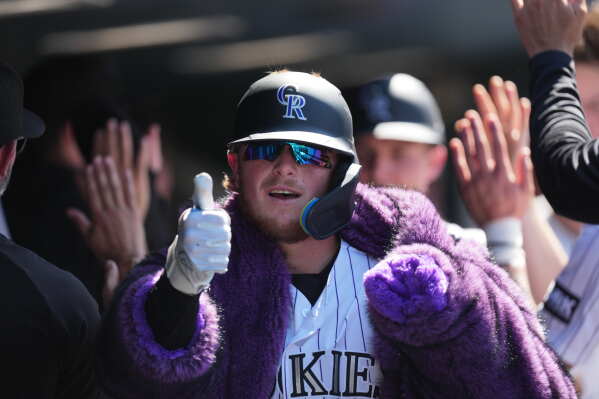
Hunter Goodman Is Under Control Until 2030. So Why Is Colorado Even Considering Trading Him?
Small-market MLB teams have a well-worn playbook for competing against bigger-payroll rivals: when a homegrown player's price is about to spike, sell high, stockpile prospects, and rebuild around the return. It's how the Nationals turned Juan Soto into CJ Abrams and James Wood, both now All-Stars leading Washington's next core. The strategy can work.
But that playbook exists to solve a specific problem: a star getting expensive, close to free agency, with too little time left to build around him. Hunter Goodman doesn't have that problem. Not even close. And that's what makes Colorado's current trade deadline dilemma so strange.
A Homegrown Star, Not a Rental
Goodman isn't a pending free agent Colorado has to cash in before he walks. He's a 26-year-old, back-to-back All-Star catcher making $810,000 this season, just reaching arbitration, and controlled through 2029 or 2030 depending on his service time. Multiple recent reports agree on the basic fact: the Rockies hold his rights for three to four more full seasons before he can even think about free agency.
He's also producing like a player worth building around, not shopping. Goodman has tied his career high in home runs, is hitting for a career-best OPS, and made his first All-Star team this season on a power bat that plays anywhere not just at altitude. Dating back to last season, his road numbers actually top his home numbers: a .262/.312/.557 line and 36 home runs away from Denver, compared to .276/.335/.497 and 22 home runs at Coors Field. For a Rockies hitter, that's the opposite of the usual skepticism, the production travels.
He's doing it at the sport's most demanding position, too, at a level Colorado hasn't had there in years. As one longtime Denver columnist put it, the Rockies have had decent catchers before, but never a star, until now. They'd be hard-pressed to replace him even once they're actually competitive again.
The Case for Selling Doesn't Hold Up
Here's the argument for trading Goodman anyway, as made by rival evaluators and some ex-front-office voices: turn one great asset into several cheaper, controllable pieces, and let that quantity fuel the next contending window. It's the same logic that built the Wood/Abrams core in Washington.
That logic depends on one condition, though the selling team has to actually be out of time with the player. Washington sold Soto because he was a year from free agency and about to price himself out of a rebuilding payroll. That urgency doesn't exist in Denver. Goodman isn't leaving in a year, or two. Even conservatively, Colorado controls him into 2029, and possibly 2030 most of a decade, counting from his rookie emergence.
Trading a homegrown, cost-controlled, still-improving star four-plus years before he can leave isn't selling high out of necessity. It's selling high out of impatience.
If the Model Worked, Why Sell the Result?
This is where the Abrams comparison earns its keep not as proof the strategy works, but as a warning about what happens after it does.
The Soto trade is supposed to be the success story. Washington absorbed a brutal short-term loss dealing a top-five player in his early twenties and turned it into exactly what a rebuild is designed to produce: multiple young, controllable, All-Star-caliber players anchoring the next core. Abrams and Wood aren't hypothetical anymore; they're delivering. By the standard the Nationals set in 2022, the plan worked.
So why, a few seasons later, is Washington reportedly listening to offers on Abrams himself?
That's the part of the cycle nobody talks about enough. Selling a star because a team ran out of time with him is one thing. Selling the player acquired in exchange for that star the very outcome the original trade was supposed to produce is another, because now he's simply become valuable enough to flip again. If Washington trades Abrams, it isn't fixing a mistake. It's running its own success story back through the same machine, treating a finished rebuild as just another asset waiting to be converted into the next one. At some point, does a team ever get to keep what it built?
That's the trap Colorado should study, not repeat. Goodman is the Rockies' version of "it worked" , a homegrown, improving, cost-controlled star at a premium position, the exact type of player a sell-and-rebuild strategy exists to eventually produce. Trading him now wouldn't be Colorado learning from Washington's success. It would be skipping straight to Washington's current temptation, without ever banking the years in between where the plan actually pays off.
So Why Not Just Extend Him?
If there's no urgency to trade Goodman, the obvious follow-up is: why not remove the rumors from the conversation entirely and lock him up?
It's a fair question, and not one Colorado answers easily. The organization has leaned on extensions before, sometimes to its regret several long-term deals aged poorly, leaving the Rockies paying declining veterans they might have traded at peak value instead. That history is likely part of why some evaluators are pushing the front office toward a trade over a new contract.
But that history is also why this moment matters. Colorado has new leadership after parting with longtime GM Bill Schmidt and hiring Paul DePodesta as president of baseball operations, a chance to make a different kind of call than the ones that produced those regrettable deals. Goodman is 26, already performing at an All-Star level, holding down a premium defensive spot, and trending up rather than down in the underlying numbers. That's a very different extension profile than locking up a player already in decline. If Colorado can get "build around your core player" right anywhere, it's here: don't sell four-plus years of control early, and don't repeat old extension mistakes either negotiate on Colorado's terms now, before some other front office convinces the Rockies that quantity beats keeping the asset already in their own lineup.
The Real Question Isn't "Sell or Keep." It's "Why Is This Even Urgent?"
The small-market trade-and-rebuild cycle exists because teams run out of time with their stars. Colorado hasn't run out of time with Hunter Goodman not by years. Trading him now wouldn't be selling high out of necessity; it would be starting the very cycle this piece is warning about, one step earlier than it needed to. If the Rockies want to be relevant over the next five years, the team-building that actually works isn't finding the next Goodman to draft and eventually flip. It's keeping the one they already have.
Author
Zack Lerdall
Engagement
Comments: 0
Loading engagement...